



Insurance typically covers genetic testing when a licensed clinician orders it as medically necessary or clinically useful for an active diagnosis, treatment decision, or documented family risk. Screening tests and most direct-to-consumer kits are usually excluded. The Genetic Information Nondiscrimination Act protects you from health insurance discrimination based on genetic results, but it never requires an insurer to pay for testing. Your first move: confirm the test name and CPT codes with your provider, then request prior authorization before any sample is collected.
TL;DR:
- Payers look for symptoms or documented family risk, evidence supporting the test, and a clear explanation of how results change treatment or monitoring.
- Medicare contractors can apply different local rules, Medicaid coverage varies by state, and employer plans may differ even when the same insurer administers them.
- Before collection, obtain the performing lab’s exact test name and CPT or HCPCS code, then have your provider submit clinical notes and request prior authorization.
- Even approved testing can leave you paying the negotiated rate if your deductible remains unmet, and labs outside your network may charge more.
- Appeal deadlines often range from 30 to 180 days; check the denial letter, and ask the lab to verify any disputed billing code promptly.
Table of Contents
- When Insurers Will Pay: Medical Necessity and Clinical Utility Explained
- Key U.S. Laws and Programs That Shape Coverage
- How Payers Decide: Billing, CPT Codes, and Lab Reporting
- Out-of-Pocket Costs and Payment Realities
- Step-by-Step: How to Check and Secure Insurance Coverage Before Testing
- Direct-to-Consumer Tests and Why Insurers Usually Won’t Pay
- If Your Claim Is Denied: Appeals, Coding Corrections, and Advocacy
- Overview of How Employer-Sponsored Insurance Plans Handle Genetic Testing Coverage
- Differences in Coverage for Genetic Counseling Services Associated With Genetic Testing
- Impact of State Laws and Variations Beyond Federal GINA Protections
- Why Preparation Changes the Outcome
- How We Support Your Genetic Testing Decisions
- FAQ
- Sources
When Insurers Will Pay: Medical Necessity and Clinical Utility Explained
Payers use two overlapping concepts to decide whether a genetic test gets reimbursed: medical necessity and clinical utility. Medical necessity means the test result will directly shape a treatment decision for a condition you already have or are strongly suspected of having. Clinical utility goes a step further and asks whether the information actually changes what a doctor does next, not just what you know about yourself.
Medicare’s own coverage guidance illustrates this distinction clearly. Under CMS billing and coding rules for molecular pathology and genetic testing, the ordering physician must have an established clinical relationship with the patient and must intend to use the results for immediate management decisions. Pre-symptomatic screening, where no symptoms or treatment plan exist yet, is commonly excluded from Medicare benefits.
This plays out in predictable patterns across commercial payers too. Tests that tend to clear the medical necessity bar include:
- Diagnostic panels ordered for a patient with symptoms suggestive of a specific genetic disorder.
- Guideline-backed oncology testing, such as tumor profiling that determines eligibility for a targeted therapy.
- Prenatal tests recommended by professional societies for pregnancies with elevated risk factors.
Tests that commonly get denied include population-wide screening panels offered to asymptomatic people with no family history, and predisposition testing ordered out of general curiosity rather than a documented clinical concern. A policy review published through NIH’s NCBI Bookshelf found that payers lean heavily on evidence reviews and professional society guidance when making these calls. Guideline-backed tests, like certain prenatal and diagnostic panels, are far more likely to be reimbursed than tests without strong evidence behind them.
That same review notes something practical: payers rarely publish exhaustive lists of covered versus excluded tests. Coverage decisions happen case by case, often based on the clinical narrative a provider submits along with the order. This is why a prior authorization or pre-determination request, submitted before testing, tends to be the most reliable way to know what you will actually owe.
Some payer clinical policies spell out specific criteria you can expect to see on a denial letter or coverage policy document. These typically require that the patient show clinical features consistent with the condition being tested for, that family history establishes a direct and documented risk, that results will meaningfully inform treatment or monitoring decisions, and that the test itself is supported by peer-reviewed literature. If your clinician’s order and supporting notes do not speak to each of these points, a denial becomes much more likely, regardless of how useful the test might be in principle.
The gap between what a test can tell you and what a payer will pay for comes down almost entirely to whether a result changes a treatment pathway today. If you are weighing a predictive test out of general interest rather than a current clinical concern, our genetic testing cost guide breaks down typical price ranges so you can plan for paying out of pocket if needed.
Key U.S. Laws and Programs That Shape Coverage
Several federal frameworks determine what insurers can and cannot do with your genetic information, and none of them guarantee payment for the test itself.
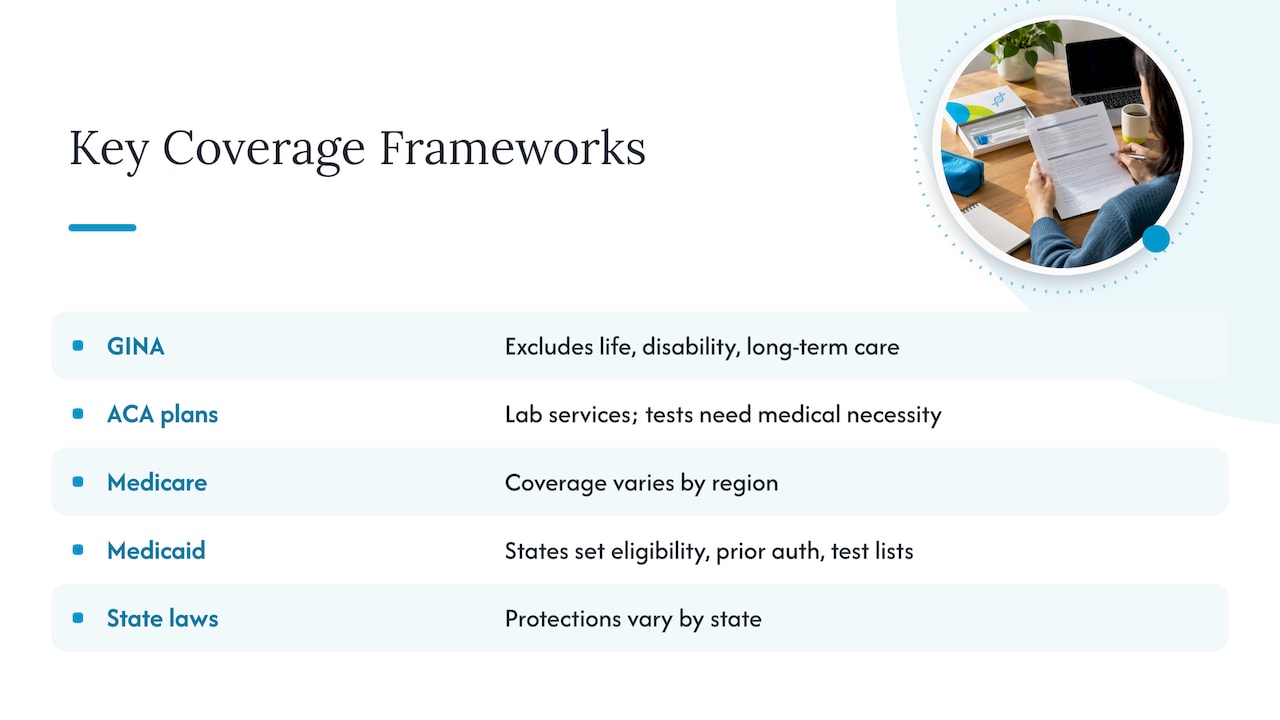
The Genetic Information Nondiscrimination Act (GINA), passed in 2008, prohibits health insurers from using your genetic information to deny coverage, set your eligibility, or adjust your premiums. It also restricts employers from using genetic data in hiring, firing, or promotion decisions. GINA’s protections have real limits, though: they do not extend to life insurance, disability insurance, or long-term care insurance. If you are considering genetic testing partly to inform decisions about those other policy types, it helps to apply for them before testing, since GINA will not shield you there the way it does with health coverage.
Marketplace plans sold under the Affordable Care Act must cover a set of essential health benefits, including laboratory services, according to Healthcare. That requirement does not translate into automatic coverage for every genetic test. Marketplace insurers still apply medical necessity standards, so a test has to clear the same clinical utility bar we covered above before a marketplace plan will pay for it.
Medicare and Medicaid add their own layers of complexity. Medicare’s national and local coverage determinations set baseline rules, but Medicare Administrative Contractors issue Local Coverage Determinations that vary by region, meaning the same test can be covered in one state and denied in another depending on local policy language. Medicaid programs are run by individual states, so eligibility, prior authorization requirements, and covered test lists differ considerably depending on where you live.
State laws can also add protections beyond GINA, particularly around genetic privacy and insurer use of results for policies GINA does not cover. These protections vary enough by state that it is worth checking your own state insurance department’s website or a genetic counselor familiar with local rules before assuming you are covered.
How Payers Decide: Billing, CPT Codes, and Lab Reporting
A huge share of genetic testing denials have nothing to do with whether the test was medically appropriate. They happen because of a mismatch between the billing code submitted and what the payer’s system recognizes.
Genome points to a structural problem: there are far fewer standardized CPT codes than there are genetic tests on the market, and new genomic assays are released faster than coding systems can keep pace. When a lab bills using a generic or stacked code instead of the precise code for the exact test performed, payers often flag the claim for denial simply because they cannot verify what was actually run.
This is why getting the exact CPT or HCPCS code, along with a clear lab test descriptor, matters as much as the clinical reasoning behind the order. Labs and ordering clinicians should provide these codes along with a short clinical narrative that cites relevant guideline references, and you should get this information in writing before your sample is even collected.
Prior authorization and pre-determination requests follow a fairly consistent pattern across payers. Your provider’s office typically submits:
- The exact test name and CPT/HCPCS code from the performing lab.
- Clinical notes documenting symptoms, diagnosis, or family history that justify the order.
- A statement describing how the result will change your treatment or monitoring plan.
Pro Tip: Ask your provider’s office for a copy of the prior authorization submission itself, not just a verbal confirmation that one was filed. Having the actual document in hand makes it far easier to appeal if the claim is later denied.
A few practical habits reduce denial risk substantially. Request a written pedigree or family history summary if your test is based on inherited risk, confirm your provider includes genetic counseling documentation when available, and ask the lab directly whether it participates in your insurance network before your sample ships out.
Out-of-Pocket Costs and Payment Realities
What you actually pay depends heavily on whether the test clears medical necessity review, whether the lab is in-network, and where you stand on your deductible for the year.
Single-gene tests tend to sit at the lower end of the cost spectrum, while larger panels and whole-exome or whole-genome sequencing cost substantially more when billed without insurance. These figures vary by lab and test complexity, so treat any number you see as a starting point for a conversation with your provider and the performing lab, not a guarantee. Our cost breakdown guide walks through typical price ranges and the questions worth asking before you commit to a test.
Even when a test is approved, your deductible, coinsurance, and network status still determine the final bill. If you have not met your deductible for the year, you may be responsible for the full negotiated rate even with an approved claim. Out-of-network labs often bill at a higher rate than in-network ones, and some insurers apply stricter medical necessity review to out-of-network claims specifically.
MedlinePlus advises a simple but important step here: if your doctor recommends genetic testing, contact your insurance company directly to confirm coverage before the test happens, rather than assuming a doctor’s order guarantees payment.
When coverage is denied or the clinical picture does not meet medical necessity standards, many labs offer self-pay pricing that is lower than their standard billed rate. Some also offer financial assistance programs for patients facing a denial. Asking the lab’s billing department about self-pay rates before you decide to skip testing altogether is worth the five-minute phone call.
Step-by-Step: How to Check and Secure Insurance Coverage Before Testing
Securing coverage is less about luck and more about sequencing. Follow these steps in order, and do not skip the documentation steps even if your provider seems confident the test will be approved.
- Confirm the clinical indication. Ask your provider to document, in your chart notes, the specific symptom, diagnosis, or family history that justifies the test, in language that ties directly to how results will change your care.
- Get the exact test details. Request the full test name, the performing lab’s name, and the precise CPT/HCPCS code or codes from the lab’s order form, not a general description.
- Submit prior authorization or pre-determination. Have your provider’s office submit the request with clinical notes, a pedigree if relevant, and citations to professional guidelines supporting the test.
- Confirm billing and network status. Ask who will bill you, the lab or the ordering clinician, and verify directly with the lab whether it participates in your specific insurance network.
- Keep every confirmation in writing. Save the pre-determination approval letter or email, and if the claim is later denied despite that approval, use it as your first piece of evidence in an appeal.
Pro Tip: Call your insurer’s member services line yourself after your provider submits the prior authorization, and ask for a reference number and the expected turnaround time. A second confirmation from the payer side catches mismatches before they become a surprise bill.
Most denials trace back to a missing step somewhere in this sequence, usually an imprecise CPT code, a prior authorization that was never actually filed, or clinical notes that describe the test without explaining how the result changes treatment. Working through these five steps in order closes most of those gaps before they start.
Direct-to-Consumer Tests and Why Insurers Usually Won’t Pay
Direct-to-consumer genetic tests, the kind you order online and swab at home without a clinician involved, are almost never covered by insurance. MedlinePlus explains why: these tests are generally excluded from medical necessity coverage because no clinician ordered them, lab quality standards vary widely across DTC companies, and payers have policies against reimbursing tests that duplicate clinically validated testing.
If a DTC result flags something concerning, you are not stuck. The path to potential coverage runs through a clinician-ordered, CLIA-certified confirmatory test. Bring your DTC results to a doctor or genetic counselor, who can order a validated follow-up test through an accredited lab if the clinical picture supports it. That order, backed by documented symptoms or family history, is what gives the follow-up test a real chance at meeting medical necessity standards, unlike the original DTC kit.
For readers weighing wellness-oriented DNA insights against clinically diagnostic testing, our piece on what your DNA reveals about your weight loss goals draws a useful line between personalized wellness information and diagnostic-grade testing that a payer might reimburse. If you want a broader grounding in how screening differs from diagnostic testing before you decide which path fits your situation, this practical guide to genetic screening is a useful starting point.
If Your Claim Is Denied: Appeals, Coding Corrections, and Advocacy
A denial letter is rarely the end of the conversation. Start by reading the denial code closely, since most describe a specific reason, like “not medically necessary,” “experimental,” or “incorrect billing code,” and each reason calls for different evidence.
If the denial cites a coding issue, your first call should go to the lab’s billing department to confirm the CPT code submitted matches the exact test performed. Coding errors are common and often the fastest denials to overturn once corrected.
If the denial cites medical necessity, your appeal should include clinical notes from your provider, a genetic counselor’s letter if one was involved, your documented pedigree, and references to professional society guidelines supporting the test for your specific clinical situation. When a payer requests records for medical review, these are the strongest pieces of evidence for overturning a denial.
Internal appeals typically have a defined window, often 30 to 180 days depending on your plan, so check your denial letter for the exact deadline and file before it closes. If your internal appeal is also denied, you generally have the right to request an external review through an independent third party, a right guaranteed under most state and federal insurance regulations.
A genetic counselor can be one of your strongest allies here. Many have direct experience writing the kind of clinical justification letters payers respond to, and some employer or hospital systems provide access to one at low or no cost. Patient advocacy organizations and, in more complex cases, a healthcare attorney familiar with insurance appeals are additional resources worth considering if a denial involves a significant dollar amount or a recurring treatment decision.
Overview of How Employer-Sponsored Insurance Plans Handle Genetic Testing Coverage
Employer-sponsored plans follow the same medical necessity framework as marketplace and individual plans, but the specifics vary by the plan your employer selected and the insurer administering it. Self-funded employer plans, where the employer bears the financial risk rather than a traditional insurer, sometimes set their own coverage policies within federal guardrails, which means two companies using the same insurance carrier can still have different genetic testing coverage rules.
GINA’s employment provisions matter directly here: employers cannot require genetic testing as a condition of employment or use genetic information in hiring or benefits decisions. Where this gets more nuanced is employer wellness programs, which sometimes offer incentives tied to health assessments that touch on family history or genetic risk. Our partner guide on GINA and wellness programs breaks down what employers can and cannot legally request in that context.
If your coverage comes through an employer plan, your HR benefits team or the insurer’s member services line can confirm whether your specific plan is fully insured or self-funded, since that distinction affects which coverage rules apply to your genetic testing request.
Differences in Coverage for Genetic Counseling Services Associated With Genetic Testing
Genetic counseling sessions are often billed and evaluated separately from the test itself, and coverage can diverge in either direction. Some payers cover a counseling visit readily, since the session itself does not require the same medical necessity threshold as the test, while the test ordered afterward still faces full review.
Other payers require genetic counseling as a prerequisite before they will even consider authorizing certain tests, particularly for hereditary cancer panels or prenatal testing. In those cases, skipping the counseling step can result in an automatic denial regardless of how clinically appropriate the test itself might be.
Counseling sessions are typically billed under their own CPT codes, separate from the lab test codes, so a denial on one does not necessarily mean a denial on the other. If your provider recommends genetic counseling as part of your testing plan, ask specifically whether your insurer requires it as a precondition for test approval, since that single question can determine your entire coverage outcome.
Impact of State Laws and Variations Beyond Federal GINA Protections
GINA sets a federal floor, not a ceiling, and several states have passed their own laws extending genetic privacy and nondiscrimination protections further than federal law requires. Some state statutes close gaps GINA leaves open, such as extending nondiscrimination protections to life, disability, or long-term care insurance, areas where federal GINA explicitly does not apply.
These state-level protections vary considerably in scope and enforcement, which means your actual legal protection against genetic discrimination depends partly on your state of residence, not just federal law. Medicaid coverage rules for genetic testing also vary by state, since each state administers its own Medicaid program with its own prior authorization requirements and covered test lists.
If genetic privacy or coverage protections beyond GINA matter to your decision, checking your state insurance department’s website or consulting a genetic counselor familiar with your state’s specific statutes gives you a clearer picture than relying on federal law alone.
Why Preparation Changes the Outcome
The pattern we see again and again is that coverage outcomes depend less on the science behind a test and more on how well the paperwork tells the clinical story. A test that is genuinely useful for your care can still get denied if the documentation does not connect the dots between your symptoms, your family history, and what the result will change about your treatment.
Preparing a clear clinical narrative before you submit for prior authorization, including a documented family history and genetic counseling notes when they are available, consistently makes the difference between a quick approval and a drawn-out appeal. We encourage anyone considering genetic testing to treat the documentation step with the same seriousness as choosing the right test in the first place.
We also believe genetic counseling deserves a bigger role in this process than it usually gets. A counselor’s letter carries weight with payers precisely because it translates family history and clinical risk into the language insurers are trained to evaluate. Building that step into your plan early, rather than after a denial, tends to save both time and money.
— Derrick
How We Support Your Genetic Testing Decisions
Navigating insurance coverage for genetic testing can feel like a lot to sort through on your own, which is exactly why we built our free health assessments and consultations around helping you make sense of your options before you commit to a test or a treatment path.

During a health assessment, we walk through your health history and goals together, so you have a clearer picture of whether a diagnostic test, a wellness-oriented panel, or a different next step fits your situation best. We combine scientifically researched guidance with a genuinely personal conversation, and our approach supports community health initiatives that extend essential services to underserved populations.
If you are ready to talk through your testing questions with real support behind you, sign up for your free health assessment and consultation and take the next step with us.
This article is general information, not a substitute for advice from a qualified doctor. Consult a qualified healthcare professional about your own circumstances before acting on anything here.
FAQ
Is genetic testing covered in insurance?
Genetic testing is covered by insurance when a licensed clinician orders it as medically necessary for an existing diagnosis, symptom, or documented family risk. Screening tests for asymptomatic people and most direct-to-consumer kits are typically excluded. Confirming coverage before testing through prior authorization is the most reliable way to know your specific situation.
How much does genetic testing cost with insurance?
Costs vary significantly depending on the test, your deductible status, and whether the lab is in-network, so there is no single reliable figure that applies to everyone. Our genetic testing cost guide breaks down typical price ranges across different test types to help you plan. Even approved claims can carry out-of-pocket costs if you have not met your annual deductible.
Will United Healthcare pay for genetic testing?
Coverage depends on the specific plan and whether the test meets that insurer’s medical necessity and clinical utility criteria, the same standards most major payers apply. There is no universal answer across all plans under any single insurer, since self-funded employer plans and individual marketplace plans can set different rules. Contacting member services directly with the exact CPT code is the only reliable way to confirm your specific plan’s answer.
Can I get free genetic testing?
Free genetic testing is uncommon outside of research studies or specific clinical trials, which are not guaranteed to be available for your situation. Some insurers fully cover medically necessary tests once a prior authorization is approved, which functions as free testing from your perspective even though the insurer is paying the negotiated rate. We also offer free health assessments and consultations that can help you understand whether a specific test is worth pursuing before you take on any cost.
Can I get free genetic testing through Medicaid?
Medicaid coverage for genetic testing varies by state, since each state runs its own program with its own prior authorization rules and covered test lists. When a test meets your state’s medical necessity criteria, Medicaid can cover it with little to no out-of-pocket cost to you. Checking directly with your state’s Medicaid office or your care coordinator is the most accurate way to confirm what applies in your case.
Sources
- Legal Information Institute — Genetic Information Nondiscrimination Act (GINA)
- CMS — Billing and Coding: Molecular Pathology and Genetic Testing (A58918)
- Coverage and reimbursement of genetic tests (NCBI Bookshelf)
- Healthcare